Friday, December 6, 2013

Differences

He's running because he knows he doesn't taste good (source)
When somebody mentions Thanksgiving to me, the first thing I think of is food. A lot of food. Turkey, stuffing, and cranberry sauce, and so much more. Most people have this association with Thanksgiving; and to most people it is a happy association. They love to stuff themselves with turkey, stuffing, and cranberry sauce; Thanksgiving is a very pleasant and enjoyable meal.

Call me a heretic, but I do not like Thanksgiving dinner. There are so many options better than Turkey to have as the main course: ham, steak, chicken, or bacon, for example. And Cranberry Sauce? Really people? Why do you torture yourselves? Just grab a nice pizza or a cheeseburger with fries. Both trump Thanksgiving easily.

Point is, people do not agree on food choices. Some people like this, some people like that, and no two people ever agree completely on what is better than what. My example is not even extreme; if you want to see somebody with a really strange platelet, just look up Michel Lotito (I really want to know what "natural causes" are).

Food is like literature. People do not necessarily agree on what all is good. For example, people seem to not like Pedro very much. When he describes himself as an angel fallen due to the malice of man, a lot of people seem to agree with the fallen part more than the angel part; people seem to think of him as a monster. Well, I say that he is not a monster. He comes to life, has every human he contacts flee from him and/or attack him, and then goes and hides in a hutch of some kind. What are his first instincts? What are his first actions that are not those of survive or die? He realizes that taking the DeLacey's food causes hardship on them. He prefers a diet of berries and acorns instead. Acorns, people!!! Beyond that, he even goes out of his way to alleviate the DeLacey's hardship; he piles up firewood for them every evening. It's one thing to make an effort to not harm, he goes above this by making an effort to do good. Oh, and he also is very, very quick to want to educate himself. By far, the qualities he demonstrates are more humane than monstrous.

Sure, people are going to disagree with me when I say that he is not innately terrible. But that's just part of life; everything from the necessities like food to the recreations like literature spark disagreement, discourse, and at times, strife. But part of being human is recognizing differences and living with it; we need to look to Pedro to see what happens when we do not treat others better, when we exclude and discriminate, when we gossip and ridicule because somebody's different views make them somehow less fun to hang with. Differences in opinion and attitude are by no means grounds to treat people like [school assignment, but you can fill in the blank].

Friday, November 22, 2013

Mimicry

This week we imitated some sentences from Frankenstein to (hopefully) improve our writing structure. It was... interesting, to say the least. For one, it was difficult to get them done in time. While I could have easily written three sentences in the amount of time we were given, I could not even get two sentences done when I had to match the syntax of another sentence. The need to force something into a certain structure as well as do it hastily made my sentences pretty bad; they were must mashed together words more or less that sorta made sense, kinda like Frankenstein's sentence - Abominable compared to my normal writing, hideous and revolting enough that it makes                   Mimicry Take 1: Everything looks like this
people run away when they first see it.
Now, this parallel between mimiced sentences and mimiced beings is true of just about anything that you can think of. Take food, for example. Find an exquisite quesadilla, and try to copy it.
Eat, savor, analyze the differences, and try again.
And the like. Keep doing this until you no longer have a quesadilla that tasks like you got it's parts from abby normal, and you will end up with a rather tasty quesadilla. Sure, it will not be a Cantina Bell Double Steak Burrito from Taco Bell, but do you really think that you will ever be equal to Taco Bell? And who said that you want to be equal? Sure, sometimes (ok, most of the time) I feel like an amazing feast from Taco Bell. Other times, mayaps I just want Kroger Brand Mexican-Style cheese sandwiched between two Kroger Brand tortillas with both sides seared in a skillet heated at high. Maybe for breakfast I prefer to put eggs in my tortilla, scarcely salted and with potatoes. Both can be made by mimicing exquisite quesadillas (especially the former), and all three have their time. But not all three are alike. Two are my creation, my fiddling around; the other is the product of somebody else's genius. I will never make Taco Bell quesadillas, just like I will never write writing exactly like Shelly's. But I can model the culinary achievements of Taco Bell, and hope to improve my cooking by doing so.

Tuesday, November 19, 2013

Ingredients

Picture from here
I honestly have no idea how to make a good sandwich. Sure, I am able to slap some ham, cheese, and lettuce on a piece of bread and then sandwich it with another piece of bread, but it is never anything like what I could get at a restaurant or what my mom would make. It always tastes bland and too much like a cold slab of cheese. Meh, I'll force it down because its healthier for me than the chips and cookies that I also have available, but it really isn't any good. See, I simply do not know enough about sandwich ingredients to make a good sandwich. So my sandwich never has any kind of flavor behind it besides starch and moldy lactose, and it is a chore to force down.
Picture from here

By contrast, very tasty sandwiches use all kinds of fancy ingredients, from nice veggies to nice sauces to just the right amount of cheese. When Schlotzsky's makes a sandwich, they know what they are doing. Their sandwiches are amazing pieces of awesomeness. Ingredients are very important in making a food good; the right ingredients can make the difference between a crappy fake and a authentic representation of a cultural food.

What makes Wuthering Heights different from Harry Potter, that we study one in Literature class but not the other? What makes Frankenstein that much more noteworthy than A Song of Ice and Fire? It is the ingredients of the books. While all are arguably good books (some more than others though), only Wuthering Heights and Frankenstein have the the right ingredients, the right theme, diction, tone, syntax that they are preservatives of a culture, of a society. They are what you get when you go and eat authentic Mexican food, instead of going to Qdoba, what you get when go and each authentic Italian food, not Fazolis. Furthermore, this analogy is a great representation of why not everybody can be expected to be a great writer. Nobody should expect me to make them a good sandwich; society can not expect everybody to be able to right well. Sure, I could be taught how to make a better sandwich, but I am never going to found the next Schlotzsky's. Only certain people can make phenomenal sandwiches, and only certain people can write phenomenal stories.

Friday, November 1, 2013

Translating Food


For my independent reading, I read a Russian book, One Day in the Life of Ivan Denisovich. Obviously, this book is pertinent to a literature class; otherwise, I wouldn't be allowed to read it for my independent reading. But its not English literature! It, as well as many other books studied in Literature class, like the short story by Gabriela Garcia Marquez, has to be translated first into English before it can be used to study literature.

Translating can be difficult. Sure, some languages like Spanish are distant cousins of English which that has whose separate branches are united by marriage. But some languages, like Ancient Greek and Hebrew, are of estranged branches or completely different families.

(http://www.jantoo.com/cartoons/lowres/740/74030624_low.jpg)
English does not get along with Ancient Greek and Hebrew. This means that there are frequent phrases where we really don't know what the phrase says in English, even though we know for sure what the phrase is in the original language. Consider, for example, the sentence:

I have a bit of an obsession with cookies. They are just too good - the sugar, the chocolate, the mix of crispy and soft that cannot be found in any other food. Cookies are just plain amazing.

Ancient Greek and Hebrew lacked novel concepts like punctuation, capitalization, and even spaces. So this becomes:

IHAVEABITOFANOBSESSIONWITHCOOKIESTHEYAREJUSTTOOGOODTHESUGARTHECHOCOLATETHEMIXOFCRISPYANDSOFTTHATCANNOTBEFOUNDINANYOTHERFOODCOOKIESAREJUSTPLAINAMAZING

However, they are also in a foreign language:

TENGOUNAPEQUEÑAOBSESIÓNCONLASGALLETASELLOSSONSIMPLEMENTEDEMASIADOBUENOELAZÚCARELCHOCOLATELAMEZCLADECRUJIENTEYSUAVEQUENOSEPUEDEENCONTRARENOTROCOMIDALASGALLETASSONSIMPLEMENTEINCREÍBLE

But Ancient Greek and Hebrew don't use the same alphabet as English or even a similar one. I couldn't figure out how to get Windings in this font, but if you can't imagine the terror copy and paste the phrase into Word and change the font to Windings. It is scary.

All of this seems like mere inconveniences, but it gets even worse. Syntax is all mixed up, and words do not have easy equivalents. There are two Greek words in the Bible that translate to love; the words for servant and slave are the same, some Hebrew words have unknown meaning. Without quotation marks, it is often difficult to tell when quotes end (e.g. Galatians 2:14-?). This often leads to it being basically impossible to translate without needing to make an interpretation and to confusion when the best word to translate a word as isn't perfect. For example, the "so" in John 3:16 ("For God so loved the world that he sent His one and only son so that whoever believes in Him will not perish but have eternal life") is often understood as "so much," but it really is just a connecting word that could be less succinctly translated as "in this way." Basically, Bible translation is very difficult and scholars often don't agree on how to translate a phrase.

WM bible-translations
(http://www.rsquaredcomicz.com/wp-content/uploads/2013/08/WM-bible-translations.jpg)

While brooding on this the other day, it got me wondering, "What does this have to do with food?" Because everything, ultimately, boils down to food.
Well, do we get food from another country that has been adapted to work better with our platelets here?
Taco Bell logo
(http://goodlogo.com/images/logos/taco_bell_logo_2934.gif)
Yes. American food is little more than [insert nationality here] flavored fat. Of course, there are many ways to flavor fat of the same nationality. So Mexican food gets its translation all confundled too; you have versions as widespread as Taco Bell and Hacienda. They are all equivalent to what you would eat in Mexico, but some are more Americanized further than others such that they the ingredients do not match well with real, native ingredients, its just that the overall product gives the general gist in a more "American" way. Just like Bible translations, you different versions of Mexican food are favored by different people - most people prefer Qdoba or Chipotle over Moes, but Moes still has a few fans, just like there are the rare people who prefer the NRSV over the NIV or ESV.

This comparison holds to other Americanized foods as well - Italian, Chinese, French, you name it. Picture the great diversity of just one kind of Americanized food - the varying degrees and depth of Americanization is incredible! There is one key difference where this comparison falls apart: food translators genererally don't care if the "meaning" of the food changes; if it separates competely from the gist of the original food, most people don't care. Literature translators, however, have to take extreme care to preserve the meaning of a text as they translate it - if they don't then the output will not really be a representation of the original and nobody would want to read it. So next time you set down and read a translated book, think of this - take a moment of silence in honor of the poor translator, and be grateful for time and energy they spent to bring a great piece literature to you.

Friday, October 25, 2013

What is happening to me?

My analogies scare me. Not because they are inherently threatening, but because I am reacting to food and literature in oddly parallel ways which contradict my nature. And that scares me.
Consider me first day of school in August, Confident and arrogant, I knew that I did not care about English class. I knew that I if I was given the option, I would drop English and take double research. I figured that I know how to write decently and seeing as that is all I will ever need to do English-wise I wished I could just say bye-bye to English and hello to freedom.
Anybody who knows me at all knows that I love my food and that I have a strong sweet tooth. I kept soda and pretzels and cookies in my locker as a pantry freshman year, I routinely bought snacks and kept them in my room sophomore year, and junior year it was not uncommon to find a box of cookies in my car that I would snack on while driving. I am always up to go to Taco Bell. Food is amazing, especially if it has starch or sugar or fat.
Fast forward a bit. As English class progressed, I initially had my thoughts confirmed. The independent reading list, after all, is very restricted, and not just to books that have more value to them than Harry Potter. The independent reading list is constricted to books that English professors like to waste time talking about. If it is a book that English professors as a general whole would like, it is applicable to Literature class, if not, it is not applicable to Literature class. That being said, class was somewhat more interesting than I had anticipated: even if I still considered reading stories like "Hills like White Elephants" an overall poor use of time, I did start to find some of the hidden meaning and purpose of literature interesting.
As this year started, I did nothing to change my eating habits. I just vowed, as usual, to exercise more for the primary purpose that I could eat more. I still kept cookies in my car, I still bought candy bars prolifically, I still had a tendency to eat chips every day at lunch. My teenage body can deal with it, I justified, I can worry about health when I am old. Of course, I am basically guaranteed to get diabetes when I am older... maybe cut back on sugar a little bit, occasionally order water at restaurants?
It started about a month ago. It was probably around when I read my independent reading book and actually found that it was a good book, or when I was forced one day to actually think about Literature and write a blog or an essay about it, but by now I have to say that Literature may not be completely useless after all. I am still to proud to say that I appreciate it, but I suppose it is only a matter of time before I do not have to wrap up that message in arrogance.
Two weekends ago I found myself at Kroger. I proceeded to by a package of cookie dough and eat almost half of it. Later that evening, I had a handful M&M's. Then I had some more cookie dough. When I got home from Youth Group, there was pie at my house. I had a piece with some ice cream. The next morning, I had the rest of the cookie dough for breakfast. It all tasted amazing, but I felt guilty that I was torturing my pancreas so much. So I decided that it would probably be a good idea to try to eat a bit healthy.
So we come to today. On day one of school I probably would have read every word of Wuthering Heights with a fresh sense of loathing seeping through my veins. But at this point I have to admit, the first two pages are mildly interesting, the next two pages are not too bad, the next two pages are bearable, the next two pages are merely annoying, and it is not until the ninth and tenth page that I start subconsciously reaching for the lighter fluid in an act of self defense. It could be worse, I suppose; at this point it is more the story than the book that is bothering me. I am starting to appreciate literature. What is happening to me?
Simultaneously with me realizing that Wuthering Heights is not all that bad, I started bring in lunch to school. Healthy lunch (I have staid true to Kroger and bring in all Kroger brand, however). Why would I do such a thing? Why, why, why, why, why? What is happening to me?
My lunch every day but Monday this week. Amazing, isn't it?
Granted, I, thankfully, have not been damaged by this unexpected change. I still would not simply read Wuthing Heights because I can, I would probably also avoid most Literature because there are other things I would rather do with my time. Within a two week time frame I am bringing a big bowl of pudding into school 3-5 times; I have sausage and pretzels with my lunch as well. But I do find it very odd that just as I blog about the connection between food and literature, I start seeing both good food and good literature seeping into my life in tandem. Very, very strange.

Friday, October 18, 2013

Wuthering Chinese Food


When I was a child I absolutely detested Chinese food. With the exception of egg-rolls and fortune cookies, I thought it was horrendous, thus nights when my family ate Chinese food I just simply ate two egg-rolls, a fortune cookie or two, drank some milk, and then raided the pantry in about an hour.  Not because I tried it and did not like it but because white rice is bland and everything else has vegetables in it. It does not look like a 99% meat American entree so I am not interested; I mean, who actually likes all those weird vegetables with the odd sauce and such?
http://goldendynastykent.com/wordpress/wp-content/uploads/2010/07/food1.jpg
I mean, that has brocolli and tomatoes and snap peas and weird corn-like things and mushrooms and some odd shiny sauce, among other things. Eghth, right?
When I was first given Wuthering Heights and told to read it, I was horrified. Based off what we had been told so far in class, I knew that it was going to be some stupid book about socioeconomic class and gender issues centuries ago that is completely irrelevant because we no longer live in Victorian England. Before I got into it, I complained to my mom and jokingly said that I was tempted to Spark-Notes Wuthering Heights. My mom's face transformed into a look of horror, and I quickly explained that I was just joking about Spark-Notes. Turns out, it was not Spark-Notes that had my mom horrified, rather, she was repulsed by my mention of Wuthering Heights. This only reinforced my fear and apprehension.

Some time a few years ago I decided to maybe give Chinese food a shot. I think the egg-rolls must have been low that day, and I was hungry with an empty pantry. For whatever reason, I actually ate Chinese food. Apparently that odd shiny sauce is actually rather tasty, the noodles are rather good, and vegetables are not as bad as they could have been (white rice is still bland though). Apparently, Chinese food is okay. It may not be my favorite, and I may not stuff myself as is usual for me at dinner, but it suffices when I cannot get my hands on anything whose contents is a bit less vegetable-ey, or at least more vegetable-ey in a way that I enjoy.

I had to read Wuthering Heights, sadly. It is slow, it has a lot of dialogue, and it is such that I cannot remember every detail and as such I keep messing up the reading quizzes. I do think it's overall content is dreary. But the odd shiny sauce - the diction and syntax and tone and the like - is actually pretty decent. I would much prefer something similar with less of the abnoying content in it, but I can bear it. Maybe next time I shouldn't judge a book by it's time period. Maybe next time I should give a book a chance even if it is on a topic that I either really do not want to spend time on or that I feel could be better discussed in a less droll way. For my independent reading, I am reading A Tale of Two Cities. Similar diction and syntax in the sense that even though the book is by a different author it was from the same era and region so the vernacular is the same and the syntax is similar. I am actually interested in the French Revolution, however, so I think I will actually rather like A Tale of Two Cities even though the warmest feeling I have to Wuthering Heights is that it is not a completely useless piece of garbage.
Source too big to fit, so stuffed into this link.

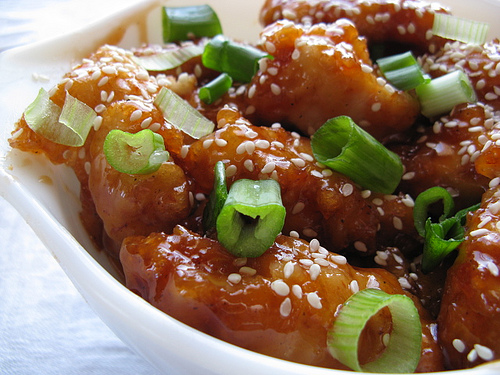
Sesame Chicken is amazing. Why? Because it is covered in that tasty shiny sauce and has so few vegetables. I still do not like Chinese vegetables. I want my stereotypical Americanized Chinesefood (not like in that video though, just thought it went well with the phase). In this manner I do not fully appreciate Chinese food. In this manner I basically say, "tasty," and move on. But I want to enjoy food, not critique it (which helps explains why I like Taco Bell). I want to enjoy a book, preferably a book with few "vegetables," and not critique it. I am sure that there is some kind of symbolism going on in Wuthering Heights that I do not understand. But I am ok with that because I want to enjoy it as best as one can enjoy that book, by which I mean I do not want be using my glazed over mind as I  read it. I just want to enjoy that glazed feeling as best as I can (glazing is good).

In short, don't judge a book by its time period. Give it a shot, it might just make it. At least try to enjoy the glazing (eat a doughnut while you read perhaps?). And keep in mind that there is always a far, far worse book out there (and a worse food).

Sunday, October 6, 2013

Analoception

Analogies are very odd sometimes. I was intending to right a post comparing qualities of food to qualities of characters, some kind of foodization. I was going to start out discussing Taco Bell's amazing menu and the different qualities that the different food on it has, like the different characters in a book all come from the same book but all have different qualities.
But then I remembered where my last blog post left off. Menus are libraries.
So, by transitive property, the set of all characters in a novel is a library. I'm not quite sure that that works.
Which is it then? How can all of this make sense?

(http://i918.photobucket.com/albums/ad22/gifsarelove/WeNeedToGoDeeper.jpg)
Deeper into the quadilla, that is. And this will collide the two analogies to synergize one that is even more amazing than either of them.
Because there are characters in a library. It's just that it's not a set of characters - its a set of a set of characters. A set of books, each with a set of characters. So it's not the qualities of the chicken quesadilla that analogize to the character traits. It's the qualities of the delectable cheese inside. The gooey-ness, the right amount of softness in the cheese. They foodize the cheese, just as the right amount of crispiness with the right amount of thickness in the tortilla foodizes the tortilla. And then you have the chicken, the auxiliary vegetables (minor foods), all of these amazing things. You mix them up in just the right way, in the right order with the right structure, and you get an amazing creation of food. Mix up characters in just the right way, in the right order with the right structure, and you get an amazing creation of literature. Then you group all of the books together in this place called a library and people can go in, get whatever book they want, free of charge, and leave. We group all of the foods together in this place called a restaurant.
There is one place where this analogy breaks down though. And I believe that it must be fixed, because it would be a marvelous improvement to the world as it is today. We need public taco bells where people can go in, get whatever food they want, free of charge, and leave.